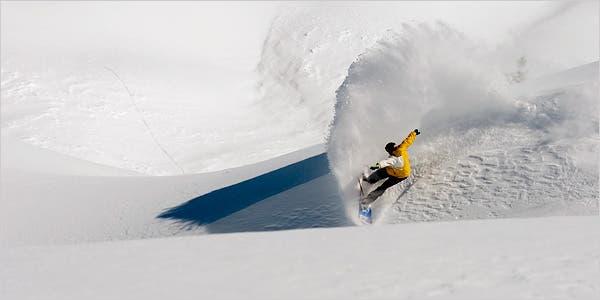
A no-boarder effortlessly carves through the untouched snow, free from the restraints of bindings.
Venturing deep into the Kootenay Range's backcountry, a group of 50 riders converged at the base of a pristine sub-alpine slope, situated three miles away and accessible only by snowmobile. The snowpack in the Interior Mountains of British Columbia was so abundant that it enveloped any evidence of logging, transforming the terrain into a haven for snowboarders, with 180 inches of powder that unveiled a paradise hidden beneath.
This exceptional setting drew in a diverse crowd, which included renowned snowboarder and X Games gold medalist, Travis Rice. However, the main attraction on that overcast Saturday was the third annual Greg Todds Memorial No-Board Race, challenging participants to descend the hill without the typical bindings that provide stability and control.
Embracing the freedom of movement, the no-boarders gracefully maneuvered through the snow, showcasing their skills and agility. Without bindings, the riders relied solely on their balance, strength, and intuition, allowing them to traverse the mountain with unparalleled finesse.
Although the race provided an electrifying experience for both participants and spectators, it also served as a platform to honor the late Greg Todds, a beloved figure in the snowboarding community. The event celebrated his passion for the sport and his fearless approach to pushing the boundaries.
No-boarding, a thrilling and recently emerged sport, challenges the conventional snowboarding experience by replacing bindings with a specialized knobbed polymer traction pad and a sturdy bungee rope. This innovative equipment, known as the No-board, transforms a traditional snowboard into a whole new adventure. Gone are the highbacks and straps; instead, riders rely on the pad's exceptional grip and secure their stance with the rope. Like skilled surfers, they adapt to the ever-changing snow conditions by adjusting their feet and center of gravity.
In the beautiful region of Revelstoke, British Columbia, Noboard Inc. is at the forefront of promoting this exhilarating sport. With a mission to push boundaries and create unforgettable experiences, Noboard Inc. offers the complete Noboard kit, comprising the essential pad, rope, and mounting hardware. Priced at 179 Canadian dollars, this kit is conveniently available on their user-friendly website, www.noboard.ca, which is currently undergoing enhancements. Alternatively, customers can place their orders via email, using the address provided on the website. Additionally, the comprehensive No-board kit is stocked in select snowboard shops across Alberta, British Columbia, Alaska, Utah, Colorado, Vermont, Europe, and Japan. Cholo Burns, one of the co-founders, proudly emphasizes the global reach of their innovative creation. For those planning a visit to Revelstoke to partake in the No-board action or witness the thrill first-hand, options for accommodations are numerous. From luxurious hotels to cozy lodges, there's a place to stay for every budget and preference. Explore your accommodation options in British Columbia at http://www.britishcolumbiahotels.net/en/ to find the perfect refuge after an adventurous day on the slopes. The charm of Revelstoke's mountain scenery coupled with the excitement of snowboarding without bindings is an experience that's not to be missed.
There is a growing number of individuals who are choosing to go without traditional snowboard bindings, opting instead for a more freestyle approach. While it is difficult to determine the exact number of people abandoning their hardware, reports suggest that 600 kits have already been sold by Mr. Burns's company. Additionally, there are many enthusiasts who are handcrafting their own kits in their cellars and garages.
One event that celebrates this no-board movement is the Greg Todds Memorial No-Board Race, a tribute to Mr. Burns's late business partner and the recognized inventor of the no-board. This race showcased an impressive range of talent, with some participants flawlessly navigating the steep slope, leaving spectators in awe. On the other hand, some riders encountered falls every 50 feet. Regardless of their skill level, almost all contestants finished the race covered in powdery snow, thoroughly exhausted, but sporting a wide grin on their faces.
Erik Leines, a professional snowboarder from Salt Lake City, decided to challenge himself by participating in the pro class, despite it being his first time trying a no-boarding event.
Describing the experience, he compared it to the exhilaration of surfing, emphasizing the freedom and excitement that comes with the loose movements and untethered feeling.
During my turn in the amateur class, I had the opportunity to borrow Mr. Burns' board. Prior to my run, he guided me through the fundamentals, emphasizing the importance of maintaining tension on the rope with my leading hand while keeping my weight well-balanced.
With Mr. Burns' instructions in mind, I made my way to the peak of the 1,000-foot slope, ready to compete against both time and four other no-boarders.
It is worth noting that Mr. Todds, a snowboarder from Alberta, played a pivotal role in Canada's snowboarding community. Unfortunately, his life was tragically cut short in 2005 following an avalanche incident near Revelstoke. He and Mr. Burns, both professional snowboarders in Whistler, initially met, but Mr. Todds made a conscious decision to move eastward, seeking the tranquility and solitude of Revelstoke to escape the fast-paced snowboarding scene.
"He had a desire to reside amidst the majestic mountains," revealed Mr. Burns, "but he grew weary of conventional snowboarding. Just a year before he invented the revolutionary no-board, he transitioned from riding in the regular stance after two decades to embracing the goofy style."
In 2001, Mr. Todds made a bold move by discarding his bindings, embedding 50 dry-wall screws into an old snowboard, and coating them with wax. He fastened a rope near the front foot, initiating a new era of exhilaration on what he dubbed the no-board.
Initially, Mr. Burns couldn't help but chuckle at the idea. However, witnessing first-hand the extraordinary feats performed by Mr. Todds navigating controlled descents down treacherous 40-degree slopes and executing flawless jumps off cornices he began to view the concept with a newfound seriousness. "From that moment on, it no longer seemed comical," he professed. "It was an entirely different experience, and what he accomplished was truly awe-inspiring." Consequently, they co-founded Noboard in 2002 to share their innovation with the world.
The roots of the modern snowboard can be traced back to Sherman Poppen's "Snurfer," innovated in 1965, which interestingly lacked bindings and resembled a compact wooden water-ski with a rope tethered to the front.
+
Mr. Burns and Mr. Todds' pioneering work with the no-board not only challenged traditional snowboarding norms but also contributed to the evolution of the sport. Their daring move to abandon bindings forged a path for unrestricted freedom, allowing riders to explore the slopes in an entirely novel fashion.
+
A testament to their invention's enduring impact, Noboard continues to inspire thrill-seekers and snowboarding enthusiasts worldwide. With countless riders embracing the no-board philosophy and pushing the limits even further, it has become evident that boundaries are merely constraints begging to be overcome.
No-boarding, a sport that involves riding mountains without the use of traditional snowboarding bindings, has become increasingly popular thanks to advancements in snowboard technology. According to Mr. Burns, no-boarding originated from the idea that experienced mountain riders could tackle slopes even without bindings, as demonstrated by the Snurfer.
The influence of Mr. Todds, a no-boarding enthusiast, has had a profound impact on the sport. His legacy prompted people to appreciate and adopt no-boarding as a way to honor him. His friend, Noah Strickland, expressed how deeply Mr. Todds' creation resonated with others.
Since Mr. Todds's passing, no-boarding has transcended its origins and gained wider popularity. Fuelled solely by passion, the sport's growth has defied traditional business models. Mr. Burns, who experienced the thrill of no-boarding firsthand, recognized its immense potential and refused to give up on it.
Mr. Burns hopes to see the sport evolve into a true supplement to skiing, snowboarding and snowshoeing. The company sponsors a team of Noboard brand riders, and produced a short no-boarding documentary, “Say Yes to the No,” which won the crowd favorite award at the Banff Mountain Film Festival in 2006.
“No-boarding is the ultimate backcountry tool,” he said, citing the advantage of not being strapped in. “You can step off the board as soon as you stop, or in the middle of the run.”
NO-BOARDING is catching on among skiers and snowboarders who want to get away from the ski hill. Mr. Burns admits that deep snow is the best place to no-board, but said that no-boarders are going for it around the world, in fields, on golf courses and on hikes.
“I knew no-boarding was going to work on the East Coast,” Chris Mask, a snowboard industry veteran from Stowe, Vt., said in a phone interview. “If you’ve got snowshoes or a boot pack, you can hit anything. It makes those six linked turns though the woods the coolest thing you’ve ever done.” Mr. Mask said he appreciated no-boarding, “because it turns snowboarding into what it was originally: a backyard sport.”
In an effort to bring more visibility to no-boarding and to his company, Mr. Burns earlier this month signed a manufacturing and distribution deal with Burton Snowboards of Burlington, Vt. Burton will make the Noboard kit and make a co-branded NoFish board.
For riders who have taken time to try the sport, no-boarding delivers on its late inventor’s aspiration to rekindle the sport’s innovative spirit and bring people closer to the backcountry. The day after the memorial race, Mr. Burns took me to a different backcountry run, through the wide-spaced spruce and fir trees higher up near the alpine. Standing above a smooth and untracked apron of powder, he repeated his advice, adding, “‘Just believe,’ that’s what Greg always said.”